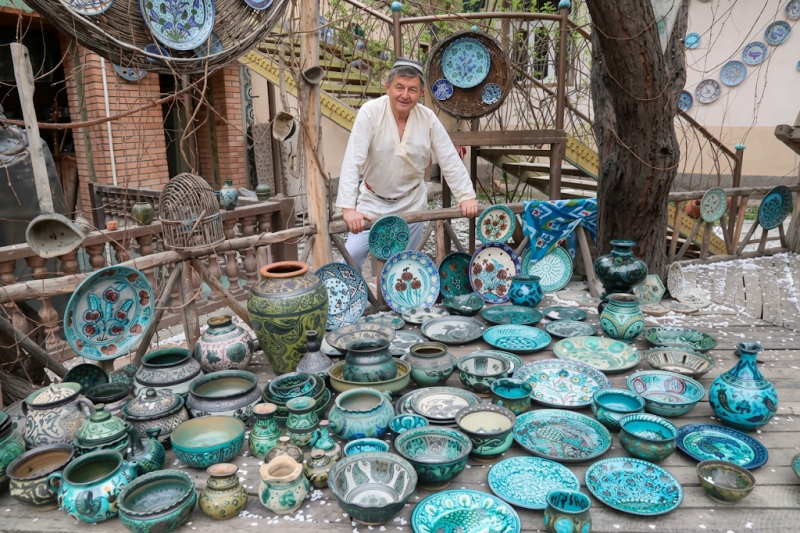
For many centuries, pottery has remained one of the leading traditional crafts of Central Asia. Ceramic products were made with both glazed and unglazed surfaces, and each famous pottery center developed its own artistic style. The differences could be seen in the shapes of the products, the character of the ornaments, the decoration techniques, and the color schemes used.
Historical centers of ceramic production have survived to this day. Among the most famous are Rishtan, Gijduvan, Khiva, Samarkand, Gurumsaray, Shahrisabz, Urgut, Khorezm, and Tashkent. Each of these centers continues to develop the techniques characteristic of its own school while adapting the craft to modern conditions.
Uzbek Ceramics
In recent years, traditional ceramics have experienced a new revival. The range of products has expanded: craftsmen produce plates, bowls, cups, water and milk containers, as well as large khums, which are used for storing food. Production technologies and product quality are improving, and production volumes are increasing.
At the same time, modern craftsmen strive to preserve the regional identity of Uzbek ceramics. They study ancient examples, bring forgotten shapes and ornaments back into production, and, alongside traditional motifs, create new decorative designs.
Different ceramic schools continue to preserve their distinctive features. For example, Samarkand craftsmen are reviving an ancient method of decorating vessels with three-dimensional elements depicting the heads of birds and animals.
Rishtan ceramics hold a particularly important place. Local craftsmen preserve both the traditional techniques of shaping vessels, carried out by kuzagars, and artistic painting, performed by usto naqqoshs. One of the distinctive features of the Rishtan school is its two-color palette. Interest has also been revived in the famous ishkor glaze, a traditional coating historically made using a dye based on plant ash. Today, more convenient ready-made alkaline glazes are also used in production.
The ornaments of Rishtan ceramics are mainly based on floral motifs. The designs may include images of kumgans (traditional water vessels), birds, fish, knives, symbols of prosperity and well-being, as well as elements of architectural decoration. One of the restored traditions is the production of decorative water vessels called musalla, whose bodies are shaped like ducks.
Tashkent also has its own distinctive approach to preserving the heritage of Uzbek ceramics. Among the well-known craftsmen is hereditary ceramic artist A. Rakhimov, the son of the famous master and researcher of Uzbek ceramics M. Rakhimov. In his work, he draws on the artistic traditions of Timurid, Kashgar, and Black Samarkand ceramics, combining the experience of different regional schools.
The modern development of pottery is also accompanied by the revival of almost forgotten traditions. In particular, the production of clay toys is being restored. In ancient times, these toys had not only everyday but also ritual significance. This craft was especially characteristic of the Bukhara-Samarkand school, where the tradition had almost completely disappeared over time.
Today, the development of Uzbek pottery is based on a combination of preserving historical heritage and pursuing creative innovation. Craftsmen are bringing back forgotten technologies and forms while creating new products, allowing this ancient craft to remain an important part of the modern culture of Uzbekistan.
 Русский
 Français