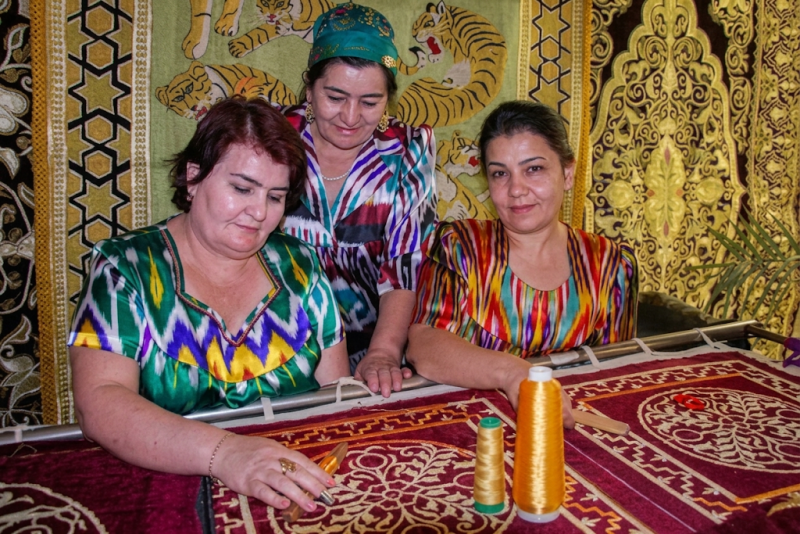
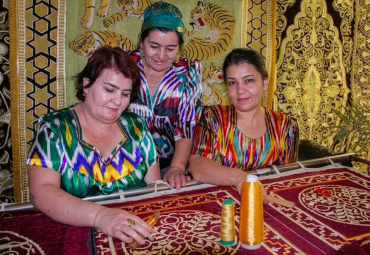
Gold embroidery holds a special place in Bukhara’s traditional decorative and applied arts. For centuries, craftsmen have used metallic threads to create intricate patterns on clothing and household items, turning everyday objects into true works of art.
Depending on the method of applying the embroidery, Bukhara gold embroiderers distinguish several main techniques. Zarduzi-zamindudzi involves almost completely covering the surface with gold thread, while zarduzi-guldudzi focuses mainly on individual ornamental, especially floral, motifs. There are also combined techniques. For example, zarduzi-guldudzi-zamindudzi combines two embroidery methods, while in zarduzi-berishimdudzi, silk elements are combined with golden patterns. In zarduzi-pulyakchaduzi, gold embroidery is complemented by shiny decorative elements.
Bukhara Gold Embroidery
The history of this craft goes back to ancient times. Written sources mention gold embroidery as early as the 14th century. However, some researchers associate its origins with an even earlier period. The character of the ornaments and the color schemes found in wall paintings from the 6th–7th centuries suggest that similar decorative traditions may have existed during the early medieval period.
Today, items from the 19th and 20th centuries are considered particularly valuable. Examples of traditional gold-embroidered clothing are preserved in the State Museum of History of Uzbekistan, the State Museum of Arts of Uzbekistan, the Museum of Applied Arts of Uzbekistan, the State Museum of the Temurids’ History in Tashkent, and the A. Ikramov Samarkand Museum of History and Culture. A significant collection is also kept in the Bukhara State Architectural and Art Museum-Reserve.
Gold embroidery was used not only to decorate clothing. Various household items were richly decorated as well, including lula-bolish — bolster cushions, takyacha — pillowcases, joypush — covers for wedding beds, takhmonpush — curtains for wall niches, joynamaz — prayer rugs, and chimillik — curtains used to divide rooms into separate areas.
Headwear also held a special place in this tradition. One of the most characteristic items was the gold-embroidered skullcap called kallapushi zarduzi. Originally, it was part of the costume of members of the court nobility. Later, it became an element of wedding attire and festive clothing worn by boys during the circumcision ceremony.
Today, Bukhara gold embroidery is experiencing a new stage of development due to the growing interest in national traditions and crafts. Men’s robes decorated with gold embroidery have become part of the groom’s wedding attire, are worn during ceremonial events, and are presented as gifts to honored guests. Modern products also include women’s vests of various lengths, skullcaps, shoes, belts, and bags decorated with gold embroidery.
Smooth velvet in rich colors continues to serve as the basis for many items, emphasizing the expressive metallic patterns. The traditional guldudzi and zamindudzi techniques remain the most widespread, although modern craftsmen continue to experiment and develop new types of stitches. Today, their number exceeds forty.
The knowledge and skills of gold embroidery are passed from master to apprentice and from one generation to another. Modern craftsmen draw not only on established techniques but also on the rich collection of historical ornaments preserved in museum collections. Their task is to reinterpret this heritage and create products that maintain a connection with tradition while meeting modern ideas of design.
In recent decades, interest in Bukhara gold-embroidered products has grown significantly. A robe made using this technique is considered a prestigious gift for an anniversary or an important occasion. The works of Bukhara craftsmen are displayed not only in museums across Uzbekistan but also in collections abroad, including in Russia, India, Indonesia, China, Sri Lanka, and other countries.
Today, Bukhara gold embroiderers continue to participate in international exhibitions, representing one of the most recognizable forms of Uzbekistan’s traditional decorative art.
 Русский
 Français